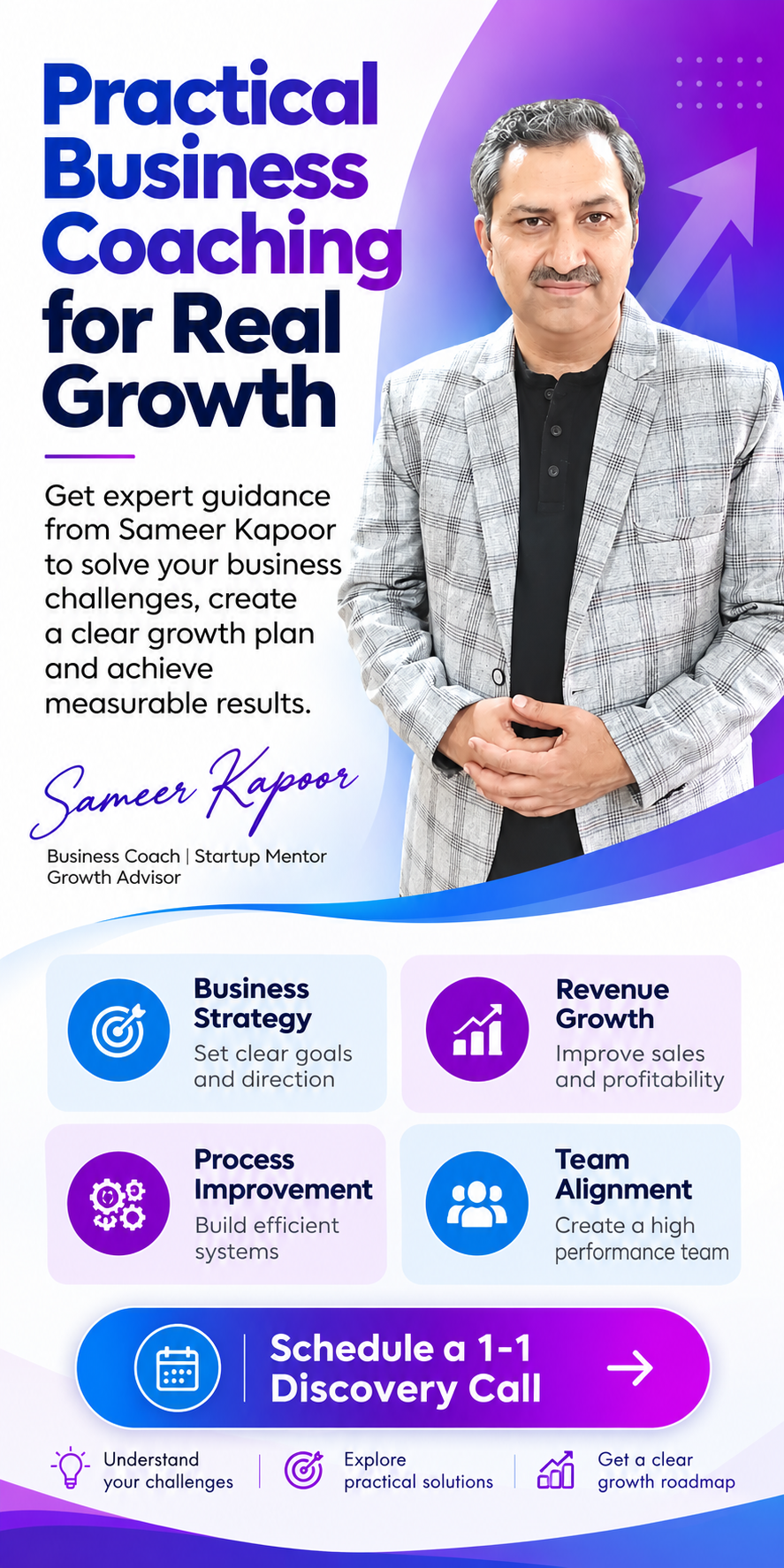

Turning a college project or business idea into a sustainable startup requires more than enthusiasm. Business mentor and growth consultant Sameer Kapoor helps aspiring entrepreneurs understand the practical realities of building a business, validating ideas and acquiring their first customers.
For many college students, entrepreneurship represents an opportunity to turn an idea into something meaningful. Instead of following a conventional career path, they aspire to develop products, launch digital platforms, solve real-world problems and build companies of their own.
India’s growing startup ecosystem has made this ambition increasingly accessible. Students can explore technology-driven business models, launch online services, develop software products and test new ideas without necessarily requiring the infrastructure associated with traditional businesses.
However, the transition from student to entrepreneur is not always straightforward. A promising idea does not automatically become a viable business. Young founders must learn how to identify paying customers, understand market demand, determine pricing, manage limited resources, build teams and generate revenue.
For graduates entering the entrepreneurial world directly from college, practical business guidance can help bridge the gap between academic knowledge and the realities of running a company. This is where Sameer Kapoor, an MSME business coach, startup mentor and growth consultant with more than 20 years of business consulting experience, can offer a valuable perspective.
Why Young Founders Need More Than a Business Idea
College provides an opportunity to develop technical knowledge, creativity, analytical thinking and problem-solving skills. Yet building a startup requires additional capabilities that are often learned through experience.
A young founder may be able to develop an application or design a product but struggle to identify the right customer segment. Another may build a technically impressive solution without establishing whether customers are willing to pay for it.
Some founders spend months perfecting a product before speaking to prospective customers. Others invest in branding, office space or technology before validating demand. These decisions can consume limited resources before the business has demonstrated a viable commercial opportunity.
A structured startup mentoring process can help founders address these risks early.
Rather than beginning with the question, “How do I build my startup?”, aspiring entrepreneurs should first ask:
- Which specific problem am I solving?
- Who experiences this problem frequently enough to pay for a solution?
- How are these customers solving it today?
- What makes my proposed solution different?
- How can I test demand before investing substantial time and money?
These questions help transform an idea into a business hypothesis that can be tested in the real market.
From Idea Validation to a Viable Business Model
One of the first challenges for a new founder is determining whether an idea has genuine commercial potential.
Entrepreneurs can become emotionally attached to their ideas, making it difficult to distinguish personal enthusiasm from customer demand. Market validation provides a more objective starting point.
Sameer Kapoor’s business mentoring approach can help aspiring founders structure this process by examining the target market, customer problem, competitive landscape, value proposition, revenue model and route to market.
For example, a student planning to launch an education technology platform could begin by interviewing students, teachers and educational institutions. These conversations may reveal that the most pressing problem differs from the founder’s original assumption.
The founder can then test a smaller solution, obtain feedback, assess willingness to pay and refine the proposition before committing to a larger product build.
This approach encourages entrepreneurs to learn quickly and make decisions based on evidence rather than assumptions.
The objective is not to eliminate every risk. It is to identify major uncertainties early and reduce the cost of learning.
Building the First Product Without Overspending
Young entrepreneurs frequently face resource constraints. They may have limited personal savings, small teams and no immediate access to external investment.
Under these circumstances, building a fully featured product before establishing demand can create unnecessary financial pressure.
A more disciplined approach is to develop a minimum viable product (MVP): the simplest version of a solution that allows the founder to test the core value proposition with real users.
Depending on the business model, this might be a basic software prototype, a manually delivered service, a limited product range or a pilot programme with a small group of customers.
Mentoring can help founders distinguish between essential features and additions that can wait until demand becomes clearer.
It can also help them establish milestones for product development, customer feedback and commercial validation. This makes it easier to decide whether to continue, refine the proposition or explore a different opportunity.
Acquiring the First 100 Customers
For many early-stage startups, the first paying customers represent a major turning point. They provide evidence that the business is solving a problem for which someone is prepared to pay.
However, customer acquisition is often one of the least understood aspects of entrepreneurship among first-time founders.
Young entrepreneurs may assume that launching a website, creating social media accounts or running advertisements will automatically generate demand. In reality, acquiring customers requires a clear understanding of the target audience, buying behaviour, sales process and trust-building mechanisms.
Sameer Kapoor’s business growth and sales consulting experience can help new founders develop a practical customer acquisition strategy.
This may involve identifying an initial customer segment, building a list of relevant prospects, conducting customer interviews, developing a compelling proposition, creating a repeatable outreach process and measuring conversion rates.
For a business-to-business startup, the first customers might come through direct outreach, industry connections, partnerships or pilot projects. A consumer-focused venture may require a different combination of community building, content, referrals and digital marketing.
The important principle is to identify channels that work for the specific business rather than copying the marketing strategy of a larger company.
Once an initial group of customers has been acquired, founders can examine why they purchased, what they value and whether they would recommend the product to others. These insights can help establish a more repeatable path to growth.
Understanding Revenue, Pricing and Unit Economics
A startup can attract users and still struggle to become a viable business. Revenue, costs and profitability need to be considered from the beginning.
New founders should understand how the business will generate income, what it costs to serve a customer, how much contribution each sale generates and how long the company can operate with its available resources.
For example, a subscription-based startup needs to consider pricing, customer acquisition costs, retention and recurring operating expenses. A product business must also account for inventory, delivery, returns and other costs associated with fulfilling orders.
These calculations do not need to begin with a complicated financial model. A simple spreadsheet with realistic assumptions can provide a useful first view of the business economics.
A startup mentor can help founders question those assumptions, evaluate different pricing options and understand the relationship between sales growth and cash requirements.
This financial discipline is particularly important for graduates who may be operating with personal savings, family support or a limited initial investment.
Learning to Sell Before Hiring a Sales Team
Many first-time founders are comfortable with product development but less confident about selling. Some view sales as something to address after the product is complete or the company has raised funding.
This can delay the most important learning a startup needs: understanding why customers buy.
Early founders benefit from speaking directly to prospective customers, presenting their solutions, handling objections and learning how purchasing decisions are made.
Founder-led sales can help reveal which customer segments respond most positively, which benefits matter most and which objections repeatedly prevent conversion.
These insights can then inform product development, pricing, positioning and future hiring decisions.
With guidance on sales processes, customer segmentation and value propositions, young entrepreneurs can approach selling as a structured business activity rather than an uncomfortable task reserved for later.
Building a Team and Operating System from the Start
Startups often begin with two or three people handling multiple responsibilities. Informal communication and quick decisions can work well initially, but confusion can emerge as the team expands.
Founders may find themselves managing every detail, while team members lack clarity about priorities, ownership and expected outcomes.
Developing basic operating discipline early can help prevent these problems from becoming more difficult to resolve later.
This includes defining responsibilities, establishing weekly priorities, tracking a small number of meaningful performance indicators, documenting important processes and maintaining regular reviews.
Sameer Kapoor’s experience in organisational restructuring, business transformation, sales processes and management information systems is relevant to founders who want to develop these capabilities as their startups grow.
The goal is not to create unnecessary bureaucracy in a young company. It is to establish enough clarity and accountability for a small team to execute effectively.
Preparing for Funding and Investment Readiness
External investment can accelerate a startup, but raising funds should not be treated as the only measure of entrepreneurial success.
Before approaching investors, founders should understand the problem they are solving, the size and accessibility of their target market, the commercial model, customer traction, competitive differentiation and the milestones they intend to achieve with the capital raised.
An investor presentation should communicate more than an attractive idea. It should explain why the opportunity exists, how the company plans to capture it and what evidence supports the proposed growth strategy.
Mentoring can help founders organise their business model, articulate their proposition, build realistic financial projections and identify the gaps they need to address before approaching investors.
Not every startup needs venture capital. Some businesses may be better suited to bootstrapping, revenue-funded expansion, strategic partnerships or other financing routes. The appropriate choice depends on the business model, growth ambitions and founders’ objectives.
 A Practical Roadmap for College Graduates
 A Practical Roadmap for College Graduates
A structured roadmap can make the early stages of entrepreneurship more manageable.
Stage 1: Identify and validate the problem. Define the target customer, conduct interviews and test whether the problem is important enough to justify a commercial solution.
Stage 2: Develop the business model. Determine how the business will create value, acquire customers, generate revenue and manage its major costs.
Stage 3: Build and test an initial solution. Develop a minimum viable product or pilot, gather feedback and refine the offering.
Stage 4: Acquire the first customers. Establish a focused sales and marketing process, measure conversion and learn from early transactions.
Stage 5: Establish the operating foundation. Create basic financial tracking, define responsibilities and develop repeatable processes.
Stage 6: Plan the next phase of growth. Use customer evidence and business performance to decide whether to expand, refine the model, hire, seek funding or enter new markets.
The time required for each stage will vary by sector, product complexity, regulatory requirements and access to resources. The roadmap should therefore be treated as a framework for learning and execution rather than a guaranteed timeline for success.
Helping the Next Generation Become Business Builders
Sameer Kapoor’s professional focus combines business coaching, startup mentoring and growth consulting. With more than two decades of business consulting experience, his areas of expertise include business strategy, sales process improvement, organisational development, management systems and business transformation.
For graduates entering entrepreneurship directly from college, the value of mentorship lies in applying these business principles to the specific challenges of building a company from scratch.
A useful mentoring relationship can help founders ask better questions, challenge assumptions, prioritise limited resources and develop the discipline required to turn plans into action.
Entrepreneurship will always involve uncertainty, experimentation and setbacks. Mentorship cannot guarantee that a startup will succeed, but structured guidance can help founders approach decisions more thoughtfully and learn more systematically from the market.
For India’s next generation of entrepreneurs, the journey from campus to company becomes more manageable when ambition is supported by customer understanding, commercial discipline and a clear execution plan.
About Sameer Kapoor: Sameer Kapoor is an MSME business coach, startup mentor and growth consultant with over 20 years of business consulting experience. He works across business strategy, sales effectiveness, organisational development and business growth. More information is available at https://sameerkapoor.in/.